





An inspection that went fine
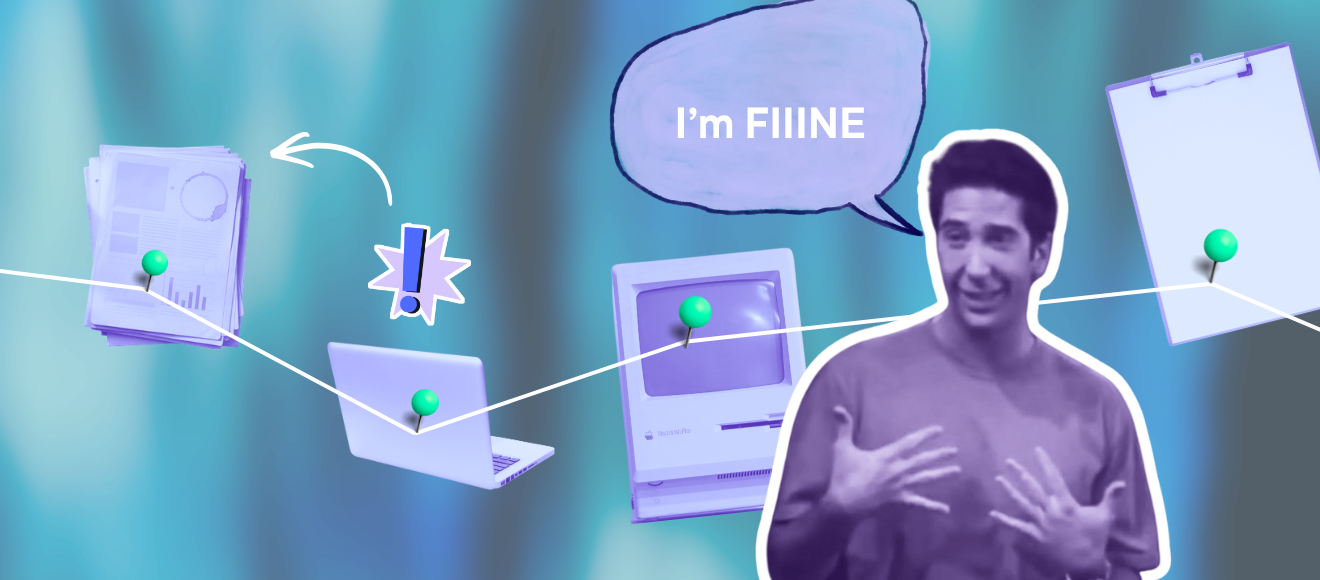
I recently caught up with a friend who works in clinical project management at a sponsor. She had come out of an inspection, so I asked how it went. "It was fine. It was totally fine." Anyone who watched Friends knows the Ross Geller version of "fine". There was a story.
The inspector had noticed one site with far more deviations than the others and asked what the team did differently there. The team had acted. They added a monitoring visit and sent more of the site's records through QC. The harder part came next: why those decisions, and where were they written down? The reasoning sat across a few email threads, some meeting notes and one person's memory.
Underneath, the inspector was asking how the team decided where to focus oversight, and where the evidence of those decisions lived. I don't have a definitive answer. I have one way of approaching the problem, built around five questions.
Committed to ICH E6(R3), not yet complete
Earlier this year, Montrium surveyed TMF professionals on ICH E6(R3). Commitment is high. 85% have started, and only 11% describe themselves as fully implemented.
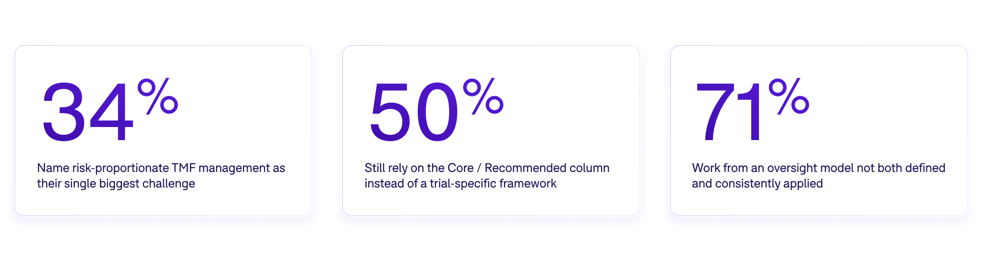 I read the 11% with caution. ICH E6(R3) defines no end state and leaves much of the how to each organization, so fully implemented means something different from one company to the next. The number marks how open the question remains, not a finish line.
The middle of the data says more. Half still work from the Core and Recommended column. Most say their oversight approach changes from study to study. Risk proportionality was the most common answer for the hardest part. Organizations are still working this out, and with good reason.
Three shifts arriving at once
While organizations work through implementation, the ground around the TMF is moving in three places.
1. ICH E6(R3) is one consolidated guideline
The principles, Annex 1 and Annex 2 now form a single guideline. Annex 2 covers decentralized elements, pragmatic designs and real-world data. In practice, more essential records now originate outside the eTMF. Remote eConsent, patient apps, home nursing visits and direct-to-patient drug shipments all create essential records, and those records live in vendor systems. The TMF increasingly has to know where evidence lives, beyond holding it.
2. The TMF Standard Model moves from reference to standard
The shift from artifacts to record groups and record types, with stable unique identifiers and richer metadata, makes TMF content machine-readable by design. Content becomes something a system reads and reasons about, in addition to something a person finds. I think this matters a great deal.
3. Regulators want visibility during the trial
FDA's Real-Time Clinical Trials pilot concerns clinical data signals reaching the agency while a trial runs. The pilot is not about the TMF, but the direction is clear. Data flow diagrams are increasingly expected too. The question is moving from "show me the file" toward "show me how you knew what was going on."
All three point the same way: a TMF more connected to the systems around it. The goal is not one big repository. Each system stays the source of truth for what it holds. The work lies in connecting the meaning between them.

From proving documents exist to proving the trial was controlled
These shifts change the job the TMF does. The table below is my attempt to describe the change.
Five of these rows carry most of the weight:
Records, wherever they live
ICH E6(R3) speaks of records, not documents, and the choice is deliberate. Much of the evidence for a trial sits in the clinical trial management system (CTMS), electronic data capture (EDC), safety systems or with a vendor, and some of it is not a file at all. The TMF stops being only the place things get filed. The TMF becomes the way you understand what exists and where.
Essentiality as a per-trial test
Appendix C gives a list, not a checklist. A record is essential when you need it to reconstruct and evaluate this particular trial. Depending on design, some records on the list will never be produced. Here the Core and Recommended column starts to feel limiting.
Filed is not done
I find this shift the most useful. A record filed, a record reviewed, an action taken and a fix working are four separate conclusions. Teams often treat them as one. An inspector asks about each.
Oversight triggered by risk signals
A monthly sweep checks everything a little. Risk signals point you to the few things needing a closer look, at the moment they need it.
Oversight captured at the moment of decision. When the reason a site was reviewed, or an issue escalated, lives only in an email thread, showing the reasoning later is hard. Captured at the time, the record is already there.
Taken together, the TMF starts to read less like proof of filing and more like a record of how the trial was controlled.
Getting there comes down to five questions. None is new on its own. Asked together and in order, each answer depends on the one before. This habit is what I mean by a connected TMF mindset.
Scale, in this context, mostly means AI. The questions matter more than the tool, and the framework stands without it. AI makes parts of the work realistic now, and I point out where in each question.
Five questions, asked in order
1. Start with what is critical to quality
The first question asks what matters most in this trial. Critical-to-quality factors are the most useful way in. ICH E8(R1) asks for them at study design, and ICH E6(R3) builds on them in section 3.10. In practice, the work has three steps.
- Planned processes: Which processes will this trial run? Consent, IP handling, safety reporting.
- Critical-to-quality factors: Of those processes, what must go right to protect participants and the reliability of results?
- Risks to control: What would undermine those factors?
Take consent. The process is obtaining consent. A critical-to-quality factor is every participant consenting on the approved version before any procedure. One risk is a version mismatch after a protocol amendment. This example returns in every question below.
Today, this work mostly happens with experienced people around a table, and their experience matters. People know things about a therapeutic area or a population no dataset holds. A room still draws only on the trials its members have worked on. At scale, the assessment starts from a wider base: findings from previous regulatory inspections, how trials with a similar design ran and where they ran into trouble, and risk signals in the protocol itself. The evidence suggests. The team decides.
Factors identified at design shape everything after: the records you expect, what you watch for and where oversight goes.
2. Define normal by information domain
The second question asks what should exist if things go as planned. One way to organize the answer is by information domain, a discrete area of trial activity with its own processes, record types and relationships, and quality and timeliness rules. Most trials have about seven, depending on design.
- ICF governance and enrolment oversight
- Investigational product accountability
- Regulatory and ethics submissions
- Safety reporting and oversight
- Delegation and site staff
- Site and centralized monitoring
- Data governance and management
Once the expected output of each domain is written down, absence becomes visible.
Expected-records lists are not new. Most answer one question: is the record there? They struggle to answer whether the record says what it should. Is the signed consent form the approved version? Does the monitoring report reference the current protocol? Does the delegation log line up with the CVs and training records? Checking today means someone reading each record, so teams check a sample. At scale, reading the content of every record becomes realistic.
Expectations also move. When an amendment changes eligibility or a procedure, the expected records change too: re-consent, new training, new submissions. Teams usually work this out through a manual impact assessment, and things get missed. The alternative is an expected picture which updates itself from the meaning of the change, with people confirming the result.
3. Route signals to the people who own them
The third question asks who needs to know, and when. In many organizations, the TMF team carries most of the load. The people who fix a consent issue usually sit elsewhere: clinical operations, regulatory, safety or the CRO.
- Every domain has an owner: Clinical operations, regulatory, safety, pharmacy, data management, and the CROs and sites acting for them.
- Signals reach the owner: The person able to act sees the issue while a fix is still possible.
- Boundaries don't break the chain: CRO and vendor evidence is evidence the sponsor relies on. The work is delegable. Accountability is not.
Back to the amendment. Amendment 02 is approved. The CRO owns sending the updated consent form to sites and is running late. Separately, site 12 changed study coordinators last month, and documenting the change sits with the clinical monitoring team. The data manager sees more queries on consent dates at the same site.
Three people, three systems, sometimes three organizations. Each sees one small thing, and none looks urgent alone. Together they suggest site 12 is consenting patients on the old version.
The CRA for site 12 and the study manager need to know, before the next patient enrols, not at the next monthly review. No single person connects signals like these across a whole portfolio, continuously. At scale, a system connects them and surfaces the result to the person who acts.
4. Turn critical factors into rules
The fourth question asks how you would know something needs attention. The consent factor from the first question becomes a set of rules.
- The ICF version in use matches the IRB/IEC-approved version in effect on the date
- Approval is on file before the version enters use
- Amendment-triggered updates go out within agreed timeframes
- Version history is complete, with no gaps
Checked continuously across every site and record, the rules produce a prioritized deviation list. An illustrative example:
The first finding shows consent obtained a week before the IRB approved the version. Across dozens of sites, sampling misses findings like this one. No team checks every record by hand, every day. Something does the looking, so people spend their time on the deciding. Deciding what a finding means stays with a person, and the domain owner is usually best placed to judge whether the finding matters.
5. Feed what you learn into the next study
The fifth question asks what changes next time. Oversight responds to what is happening, rather than following only a fixed schedule. Possible triggers include:
- A completeness threshold breached in a domain
- Milestone proximity, with thresholds tightening before lock or inspection
- Query rate escalation across any dimension
- A quality event, such as an audit finding or protocol deviation
The consent example runs around the loop. A signal surfaces: a version mismatch at one site. Someone reviews and confirms the signal. The risk score for consent at the site rises, so the site gets closer attention for a while. The rules get refined, perhaps with a tighter check on distribution after an amendment. Then comes learning.
Learning is the step easiest to miss. If a lesson does not go back into the risk assessment and the plans, the same issue tends to return on the next study. Scale matters most here. A recurring finding across studies, or with the same partner, only appears when you look across all of them. The pattern belongs in the next study's risk assessment, which returns you to the first question.
Back to the inspector's question
Return to where this started: how did you decide where to focus your oversight? Teams who asked the five questions along the way have a real answer. They show what was critical to quality, what they expected to see, who was responsible, what needed attention and what they changed. The answer is documented, traceable and reviewed by the people accountable for it.
Across studies, sponsors and CROs, the five questions produce three outputs.
People bring the judgment, the experience and the context. Technology brings reach across more evidence, sites and studies than any team covers by hand. Neither is enough alone. The connected TMF mindset puts the two together, so the story of the trial is captured as events happen instead of rebuilt before an inspection.
Every organization will answer the five questions differently. At Montrium, they shape how we define the next generation of eTMF capability, built around inspection readiness and connected clinical intelligence. Have your own answers ready, and the next inspection goes more smoothly. When someone asks how it went, you say "it was fine" and mean it.
Book a demo of eTMF Connect to see how your team moves from proving documents exist to proving the trial was controlled.

