







When it comes to 21 CFR Part 11 compliance, there's an apparent disconnect between what organizations believe they've accomplished and what regulatory standards actually require.
After years of working with life sciences companies who are digitizing their processes and implementing electronic signature solutions, we've identified several persistent blind spots that put organizations at risk during audits—and cost them significant time and money to remediate.
What are the most common 21 CFR Part 11 compliance blind spots?
I sat down with Montrium’s Director of Compliance, Gianna De Rubertis, to break down the most common misconceptions about Part 11 and reveal what it actually takes to pass an audit.
1. Not knowing you need to be compliant
"The first gap is that stakeholders are not even aware that they needed to be Part 11 compliant," explains Gianna De Rubertis, Montrium’s validation expert who has guided dozens of organizations through the compliance process.
"Some people are still relatively new in this area and unfamiliar with all the relevant regulations. You can't really blame people for not knowing what they don't know, but that doesn’t mean there aren’t consequences."
As organizations become increasingly digital, electronic records and electronic signatures are replacing paper documentation. But many teams don't realize that if they're generating or using electronic records and electronic signatures for activities overseen by the FDA, they must follow 21 CFR Part 11.
This means if you are sponsoring a clinical trial, manufacturing medicines or distributing drug products through the supply chain, Part 11 may be relevant to you. The regulation exists to ensure that electronic records and electronic signatures are trustworthy, reliable, and generally equivalent to their paper counterparts.
2. The validation gap: Your system works, but can you prove it?
Perhaps the biggest misconception is confusing a functioning system with a validated one. Organizations often believe that because they're generating what appears to be Part 11 signatures, they're compliant. This is fundamentally incorrect.
The very first article in the 21 CFR Part 11 regulation states that organizations must validate their systems to ensure accuracy, reliability, and consistent intended performance. Yet when asked in audits to provide evidence of validation, some organizations struggle to produce anything tangible.
"The system might be working properly, it's doing what it needs to do, but you can't prove it because you don't have the documented evidence that would be produced through system validation," Gianna emphasizes.
The critical question auditors ask: "Can you show me your validation documentation?" If you can't answer this question with specific documents and evidence, even if you know your organization has done it at some point, you’ll likely receive an audit finding.
Simply put: If it isn’t documented, it didn’t happen.
3. Understanding vendor responsibility vs. your responsibility
Another major source of confusion centers on who is responsible for validation. The regulation is explicit: Persons who use the system are responsible for validation. This means the organization purchasing and implementing the solution, not the vendor, is accountable for validation.
However, this doesn't mean you're entirely on your own. Vendors can provide substantial support through documentation, test results, and technical resources. The key is understanding how to leverage these materials appropriately.
"The vendor is in good conscience responsible for providing and selling a product or service that is of good quality," Gianna notes. But she draws a clear distinction using a relatable analogy:
"It's like buying a hammer from the hardware store. The manufacturer designed and built the hammer with a certain purpose in mind. But if I choose to use the hammer as a doorstop and it doesn't hold my door open, then it's not fit for my intended use.”
Determining whether a product is suitable for its intended use is ultimately the responsibility of the user.
Vendors like Adobe provide validation packs, test execution records, and technical documentation. These resources can significantly reduce your validation burden, but only if you properly evaluate and document your decision to leverage them.
You must still prepare a formal statement declaring that you've reviewed the vendor's documentation and used that to determine the system is fit for your intended use.
For more detailed information on the shared validation responsibility, please refer to our White Paper “An Analysis of Shared Responsibilities for 21 CFR Part 11 and Annex 11 Compliance"
4. The missing half: Technical controls are only part of the story
One of the most overlooked aspects of Part 11 compliance is the requirement for procedural controls. Organizations often focus exclusively on technical implementation, i.e. configuring systems, enabling Part 11 signature workflows, setting up authentication, while completely neglecting the governance layer.
"It's not just about setting up the system correctly, it's also about establishing the procedures to make sure the system is used correctly," Gianna stresses. "If people don't know how to use the system, you will lose control over the whole process."
The regulation requires more than just technical safeguards. You must also establish Standard Operating Procedures (SOPs) that address:
- System use: How to use the system correctly, and what constitutes appropriate use
- System administration: How to manage the environment
- User access management: How users gain and lose access, and who is authorized to access specific functions
- Training: Are users qualified to performs assigned tasks within the system
"All of this together—the validation, the implementation of the proper technical controls, and the establishment of the appropriate procedural controls—collectively come together to make it so that you can say that the system is Part 11 compliant," Gianna explains.
5. The costly reality of getting it wrong
We've worked with organizations that believed they were compliant based on vendor assurances, only to discover critical gaps during audits. One client came to us saying they'd had an audit the previous week, received a finding, and needed to fix the issue immediately.
The problem? They had implemented the system and were using it to collect electronic signatures but lacked the validation documentation and procedural controls to prove compliance.
The result was not just a finding, but the need to conduct a retroactive validation—a time-consuming and expensive process that delayed their operations and created uncertainty about the validity of previously signed documents.
6. Where to start If you're starting from zero
For organizations with no validation experience, the path forward can seem daunting. The regulation itself is intentionally vague, leaving room for risk-based approaches tailored to each organization's specific use case.
This flexibility is valuable but can be overwhelming.
"Every organization is going to do it slightly differently - and that’s normal”, Gianna notes. “Different organizations may be using the exact same system, but how they bring it into the organization, which features they rely on, and the context of use are going to be contingent on the business process and the people involved."
If your team lacks validation expertise, start by:
- Understanding what the regulation actually requires - Review 21 CFR Part 11 in detail.
- Evaluating vendor-supplied resources - Many vendors provide validation templates, test execution records, and technical documentation that can serve as a foundation.
- Determining your intended use - Clearly document which features you'll use and how they fit into your business processes
- Engaging quality assurance early - Quality needs to be involved from the beginning to ensure all documentation meets your requirements
- Creating a validation plan - Document your approach, including what vendor materials you'll leverage and what additional testing or supplemental documentation you'll produce
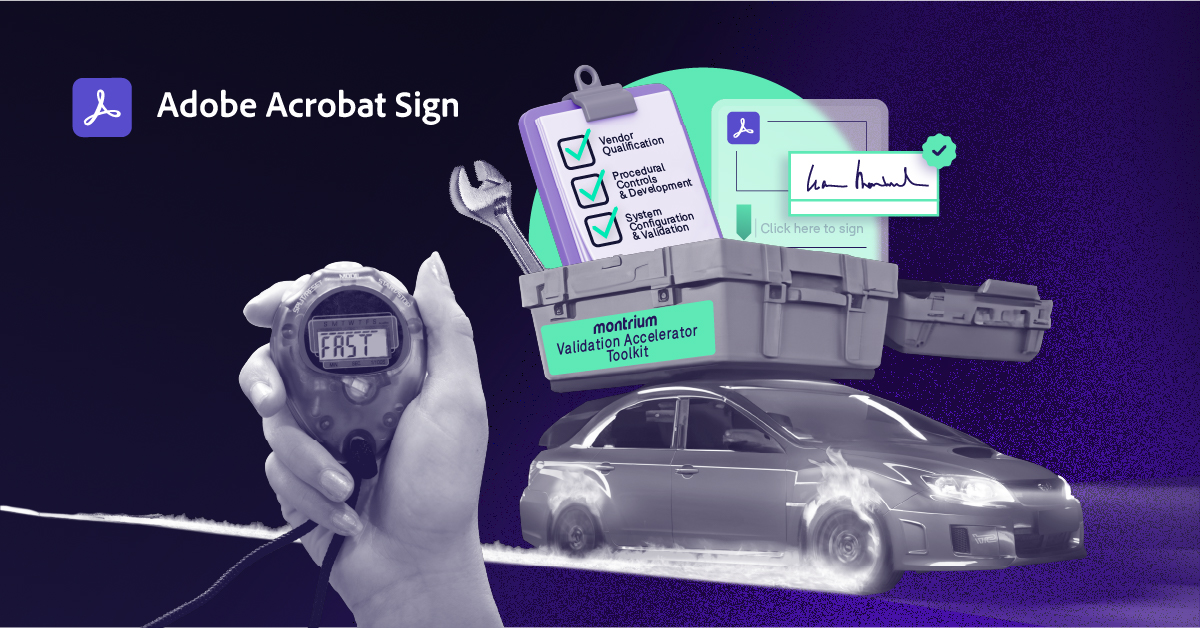
For Adobe Acrobat Sign users specifically, we've developed The Roadmap to Validating Adobe Acrobat Sign for 21 CFR Part 11 that provides step-by-step guidance through this process.
The value of Montrium’s expert guidance
Experienced validation teams have developed methodologies and learned what works across different contexts. This experience is particularly valuable for smaller organizations or those new to regulated industries.
"We've done it time and time again," Gianna explains. "We can come in and help guide with the configuration of the environment to make sure that appropriate technical controls are implemented, and we can also help with the preparation of the required SOPs."
Working with experienced validation partners can help you:
- Avoid common pitfalls and blind spots
- Leverage vendor documentation effectively
- Implement both technical and procedural controls appropriately
- Create documentation that will withstand audit scrutiny
- Get up and running faster while maintaining compliance
If you found this article because you were looking for guidance in 21 CFR Part 11 or just looking to refresh yourself on the latest in the regulation, our team of experts are more than happy to chat with you.
Whether you're tackling this for the first time or looking to assess where your organization is at now with your compliance, don't be afraid to book us here to help.
Partner with experts who've navigated these challenges before.
The bottom line: Compliance requires proof
Compliance requires documented evidence that:
- You have validated your system for its intended use
- You have implemented appropriate technical controls
- You have established procedural controls and SOPs
- You have approval from appropriate stakeholders
- You can demonstrate all of the above to auditors
Without this documentation, you're operating in a state of regulatory risk, regardless of how well your system appears to be functioning. The time to address these gaps is before an audit—not after a finding forces you into expensive remediation.
Need help navigating Part 11 compliance? Learn more about validation services and resources.


.jpeg)

.png)
-1.png)