




Which eQMS features matter most, here, now? I get this question a lot.
The eQMS features that matter most depend on organizational size and regulatory maturity:
-
Small pharma and biotech teams should prioritize Document Control, Training Management, and Deviations/CAPA, implemented quickly and validated proportionately to risk.
-
Large, multi-site organizations need cross-site process harmonization, robust integrations (MES, LIMS, ERP), and supplier governance that scales with global CSA (Computer Software Assurance) expectations.
These priorities didn't emerge in a vacuum. As Quality leaders, we've all felt the shift: regulators around the world are no longer asking for more paperwork — they're asking for better assurance, stronger data integrity, and clearer control of cloud-based systems. Guidance from the FDA, EMA, PIC/S (Pharmaceutical Inspection Co-operation Scheme), and ICH has converged, and the implications for any GxP-regulated organization are profound.
With the FDA’s modernized Computer Software Assurance (CSA) framework, the evolving EU Annex 11 revision, and the updated risk management principles of ICH Q9(R1) (International Council for Harmonisation Quality Guideline 9, Revision 1), the industry finally has a direction that aligns with how we operate today.
We are encouraged (and expected) to prioritize risk appropriate validation, transparent vendor oversight, and quality systems that scale with the speed of drug development and modern cloud technologies.
At the same time, inspections continue to reinforce one message above all others: data integrity remains the most critical vulnerability across the GxP (Good Practice) landscape. Audit trails, contemporaneous documentation, traceability, and durable electronic records are still among the most cited deficiencies globally.
Any eQMS that doesn’t operationalize ALCOA++ by design creates unnecessary risk.
That’s why the eQMS capabilities that matter today are the ones built for the regulatory reality we’re living in:
- Risk-based validation tools aligned with CSA & GAMP 5 (Good Automated Manufacturing Practice, 5th Edition)
- Embedded data integrity controls, not bolted on checks
- Cloud ready supplier governance that supports Annex 11 expectations
- Core quality workflows - documents, training, deviations, CAPA, change control -implemented in a consistent, inspection ready manner
- Lifecycle driven continuous improvement, in line with ICH Q10 (International Council for Harmonisation Quality Guideline 10) principles
As a Director of Quality Assurance, I’ve seen firsthand how organizations can transform compliance - reducing friction, increasing efficiency, and strengthening trust with regulators and partners, simply by selecting systems that align with these modern expectations.
Quality is no longer defined by the weight of your validation binders. It’s defined by the strength, integrity, and transparency of your systems.
Companies that embrace this shift and adopt eQMS platforms built for it, will move faster, withstand scrutiny more confidently, and stay future ready as the regulatory landscape continues to evolve.
If your goal is to build a resilient, inspection ready Quality organization, now is the time to invest in systems that reflect not the past of compliance, but its future.
With that context, here’s how I guide teams, small and large, on what to prioritize.
What eQMS features should small or early-stage biotech and pharma teams prioritize?
👉 Your north star is inspection readiness without hiring an army.
You do not need everything on day one. You need the right things, implemented quickly, and validated proportionately to risk.
The trio I push hardest:
- Document Control with Part 11 e-signatures and audit trails. Centralization, version control, and trustworthy signatures are how you stop living in “Which SOP is the latest?” land. FDA’s finalized Part 11 Q&A for clinical e records (Oct 2024) clarifies risk based approaches and where Part 11 applies as records move into sponsor systems; even if you’re precommercial, those habits pay off as your clinical data starts to flow.
- Training Management linked to documents. When an SOP changes, training should follow automatically. Under CSA’s lens, the LMS’s intended use dictates how much evidence you need—scripted for high risk outputs, scenario based for the rest—so you can validate quickly and defend your approach.
- Deviations/Nonconformances & CAPA - lightweight, risk aware. This is where ICH Q9(R1) comes into play: consistent severity/detectability logic, proportionate actions, transparent decisions. The point is quality of reasoning, not volume of fields.
After that, add Change Control (basic impact assessment covering validation state, data integrity, and training impact) and Supplier Qualification (foundational) - especially for cloud tools that underpin GxP operations. With Annex 11’s trajectory and GAMP 5 (Second Edition), regulators expect smarter supplier oversight for cloud/XaaS (Anything-as-a-Service (cloud-delivered software services) ), think fit for purpose questionnaires, reliance on SOC 2 or ISO/IEC 27001, and periodic remote assessments.
I’ve watched small teams stage implementations - Docs & Training first, then Deviations/CAPA, then Change Control - and reach audit ready status inside a quarter.
Two cautions:
- Don’t over validate your eQMS like it’s a product impacting Manufacturing Execution System (MES). CSA is explicit: tailor assurance to intended use and process risk and lean on exploratory testing for low/medium risk functions — with traceability. Your job is to demonstrate confidence, not to fill binders.
- Demand real security proof from your vendor. For small companies, the cost of failing a partner’s IT/QA due diligence can be a lost deal. SOC 2 or ISO 27001 has become the minimum ticket to play - and yes, your sponsors will ask.
%20(1200%20x%20600%20px)%20(6).png?width=1200&height=400&name=CTA%20-%20Blog%20(1200%20x%20400%20px)%20(1200%20x%20600%20px)%20(6).png)
What eQMS features do large, multi-site or commercial pharma organizations need?
👉 Your north star is consistency at scale and integrations.
At scale, you have a different problem: not whether the eQMS can do CAPA, but whether every site means the same thing by “major deviation”.
You need:
- Cross site harmonization of processes and data: standardized event taxonomies, reusable risk models, consistent closure/efficacy criteria, and enterprise level dashboards you can carry into Management Review. Q9(R1) pushed us all in this direction; the eQMS should make it operational.
- Robust supplier/SaaS oversight. The draft Annex 11 expects regulated users to access validation and safe operation documentation - even for cloud services. Add GAMP 5 (Second Edition) guidance on outsourcing/cloud, and the message is unmistakable: vendor qualification is not a check the box PDF; it’s an ongoing program that leverages SOC reports and/or ISO 27001 but still tests the bits that matter to your intended use.
- Interoperability. Mature programs integrate eQMS with MES/LIMS/ERP/RIM/PLM to avoid hand typing truth between systems. CSA and modern GAMP thinking encourage reusing supplier evidence, automated testing, and focusing scripted rigor where system outputs can affect product quality or patient safety. Your validation model should scale across frequent SaaS releases without rewriting a thousand scripts each time.
- Data integrity by design, globally. Automated audit trails and role based controls are table stakes; the differentiator is how efficiently you review audit trails and detect patterns.
Underneath it all sits a CSA operating model: governance that classifies functions by process risk, elevates rigor for GMP critical outputs, and embraces scenario testing for supportive features - while maintaining crisp traceability. The finalized and updated CSA materials are explicit on cloud and vendor reliance; use that to accelerate change control for every minor release your SaaS tools ship.
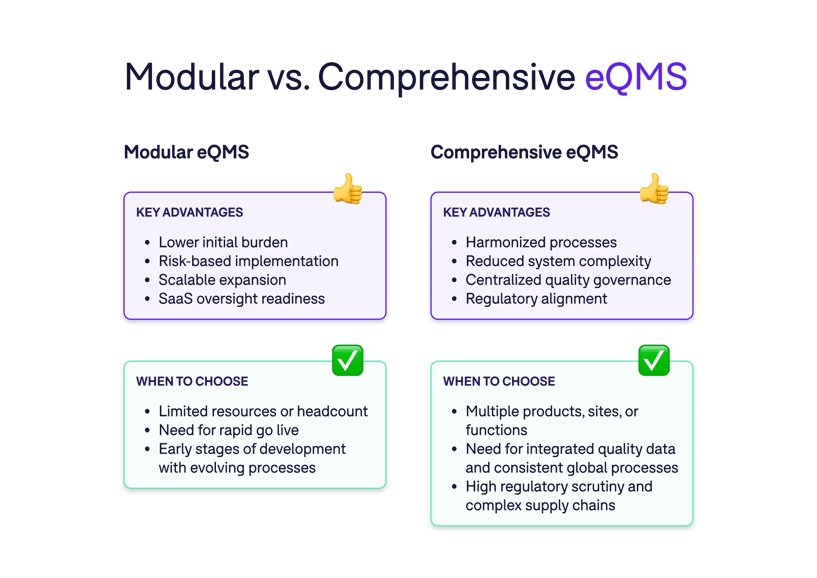
Modular vs. comprehensive eQMS: A summary perspective
Regulatory expectations across global GxP environments have evolved toward risk-based assurance, stronger supplier oversight, and cloud-ready compliance. These shifts, driven by FDA Computer Software Assurance (CSA) and the EU’s evolving Annex 11 revision, directly influence how organizations should approach the selection and deployment of an electronic Quality Management System (eQMS).
Modular eQMS approach
Best fit for: Small, early stage, or rapidly growing organizations.
Key advantages
- Lower initial burden: Reduced configuration and validation effort, enabling faster deployment.
- Risk-based implementation: Supports CSA principles, allowing proportionate validation aligned with intended use.
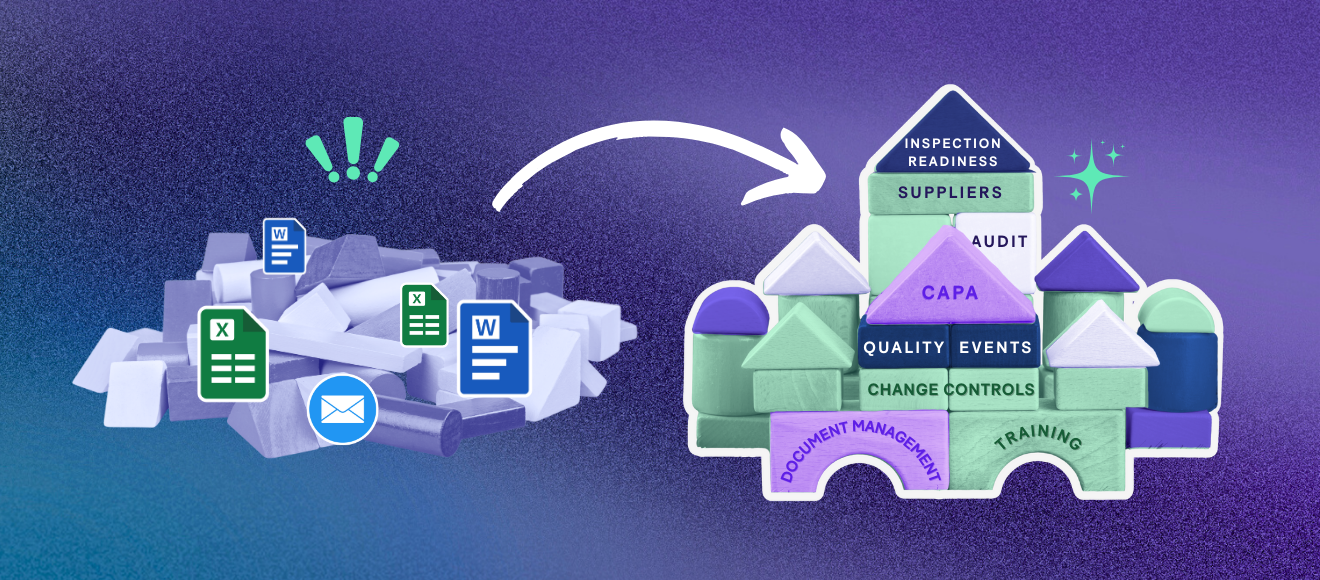
- Scalable expansion: Organizations can start with core elements (Document Control, Training, Deviations/CAPA) and add Change Control, Audits, and Supplier Qualification as operations mature.
- SaaS oversight readiness: Modular deployments align with Annex 11 expectations for appropriately qualifying and managing cloud vendors.
When to choose Modular
- Limited resources or headcount
- Need for rapid go live
- Early stages of development with evolving processes
Comprehensive eQMS suite
Best fit for: Large, multisite, or globally integrated GxP organizations.
Key advantages
- Harmonized processes: Unified taxonomies, controlled vocabularies, and standardized workflows across all sites.
- Reduced system complexity: Minimizes reliance on multiple point solutions and avoids heavy interface validation loads.
- Centralized quality governance: Single analytics layer for quality metrics, trending, and Management Review.
- Regulatory alignment: Supports GAMP 5 (Second Edition)—leveraging supplier evidence, critical thinking, and scalable lifecycle assurance.
When to choose Comprehensive
- Multiple products, sites, or functions
- Need for integrated quality data and consistent global processes
- High regulatory scrutiny and complex supply chains
Choosing between a modular and comprehensive eQMS is not a matter of one being “better” than the other, it is about selecting the model that aligns with organizational maturity, regulatory exposure, and long-term growth. A modular approach offers agility and rapid implementation for smaller teams, while a comprehensive suite provides the structure, consistency, and governance required for large, established organizations.
Both paths can fully meet GxP expectations when grounded in strong vendor oversight, lifecycle thinking, and modern, risk based validation practices.
What does an eQMS really cost? Hint: it's not just the license
For startups, the hidden cost is people’s time—configuration, migration, and SOP rewrites - more than the subscription line. CSA lets you right size validation (less scripted testing where risk is low, more where it counts), reducing services spending. Pick vendors with biotech ready templates to collapse build time.
For enterprises, the expense moves to integration and change management. Your savings come from vendor evidence reuse, standardized risk models, and release cadences that avoid “mini-CSV projects” every month. On the supplier side, budget for periodic remote assessments and document exchanges grounded in SOC 2/ISO 27001 - Annex 11’s trajectory and GAMP 5’s supplier guidance make this the new normal.
The market context also matters: the eQMS segment in life sciences continues to grow, driven by digital validation and inspection readiness pressures. The Life Sciences Quality Management Software Market Size & Share Report, 2033 estimates the global life sciences QMS software market at USD 3.27 billion in 2024, projected to reach USD 9.47 billion by 2033 at a CAGR of 12.65%.
Budget for a multiyear journey, not a one-off project
How will AI and evolving regulations like Annex 11 shape eQMS requirements?
You don’t need AI enabled QMS to be compliant. You do need your eQMS to keep good records about any AI used elsewhere in the drug lifecycle - data lineage, approvals, model versioning - because FDA and EMA are converging on high-level principles and draft guidance around AI credibility and governance. That’s coming into sharper focus (and faster) than many expected.
Meanwhile, keep your eyes on the EU’s Annex 11 timeline; its expansion of supplier/cloud expectations and data integrity controls will shape audit conversations globally, not just in Europe. The way the FDA has refined CSA to clarify cloud, unscripted testing, and vendor reliance gives you a mature playbook; apply it consistently, document your rationale, and you’ll be in a strong position on both sides of the Atlantic.
Which eQMS is right for your organization? Key takeaways by team size
If you’re small, prioritize Docs + Training + Deviations/CAPA, add Change Control soon after, and validate with CSA discipline: focused, traceable, risk-based. If you’re large, insist on harmonization, integrations, and supplier governance that scales—and build a CSA program that treats your vendors as partners in assurance, not vendors of PDFs.
In 2026, the best eQMS isn’t the one with the most modules. It’s the one that makes your risk-based decisions obvious, your data integrity indisputable, your supplier oversight defendable, and your team free to focus on the science.
Checklist for small pharma & biotech teams
Goal: Quick inspection readiness with minimal resources.
1. Foundation Modules
- Document Control with versioning, metadata, and 21 CFR Part 11 compliant e-signatures
- Training Management with roles, courses, and auto update on SOP changes
- Deviations / Non conformances (simple, risk-based)
- CAPA (lightweight but structured: root cause, actions, effectiveness checks)
- Change Control (basic impact assessment for validation state, training, and data integrity)
2. Validation approach (CSA ready)
- Validate based on intended use + process risk, not blanket testing
- Use scenario-based testing for low/medium risk functions
- Scripted tests only for high-risk features
- Maintain simple, clean traceability (requirements → tests → results)
3. Data integrity essentials
- Automatic audit trails
- Contemporaneous recording
- Role based access + permissions
- System-managed version control on records
4. Supplier & cloud oversight
- Vendor provides SOC 2 or ISO 27001 certification
- Clear SDLC (Software Development Lifecycle) documentation (DevOps/DevSecOps)
- SLA + uptime + data residency clarity
- Basic quality agreement or questionnaire completed
5. Rapid implementation readiness
- Vendor offers templates (SOP, CAPA, change control, etc.)
- Data migration support (CSV/Excel mapping templates)
- Clear admin training for your small QA team
- Staged rollout plan (Docs → Training → Deviations/CAPA → Change Control)
6. Analytics (nice to have)
- Basic dashboard: training status, overdue CAPAs, open deviations
- Exportable audit ready reports
Checklist for large pharma & biotech teams
Goal: Global consistency, scalability, and integration across the Pharmaceutical Quality System.
1. Enterprise modules
- Global Document Management with harmonized metadata
- Enterprise Training with site or region based roles
- Standardized Deviation / CAPA taxonomy across sites
- Full Change Management with workflows for validation, IT, manufacturing
- Audit Management (internal + external)
- Supplier Quality & XaaS Oversight (qualification, audits, periodic reviews)
- Risk Management aligned with ICH Q9(R1)
2. Validation & CSA governance
- Formal CSA governance model
- Centralized risk catalog for system functions
- Standard approach for scenario vs. scripted testing across all sites
- Vendor provided assurance documents reused across releases
- Automated regression + evidence reuse where applicable
3. Integrations & interoperability
- MES, LIMS, ERP, PLM, and RIM integrations planned or implemented
- API catalog reviewed for fitness
- Standard data objects (products, sites, materials) harmonized across systems
4. Supplier & cloud governance
- Documented vendor qualification program (SaaS, labs, CDMOs)
- Periodic supplier audits or remote assessments
- Review SOC 2 / ISO 27001 reports annually
- Review change notification procedures (especially for SaaS updates)
- Cloud risk assessment aligned with Annex 11 expectations
5. Data integrity at scale
- Automated audit trail review tools
- Segregation of duties across sites and groups
- Consistent backup, retention, and archiving policy across regions
- Monitoring of high risk data flows (e.g., batch release, EM/micro data)
6. PQS performance analytics
- Enterprise dashboard for CAPA effectiveness, closure cycle time
- Trending and signal detection (process + quality data)
- Management Review pack generated directly from system data
7. Global change management
- Formal process for harmonizing workflows across sites
- Rules for local vs. global process variations
- Governance board for eQMS changes
At a glance: Small vs large teams
|
Area |
Small teams |
Large teams |
|
Primary goal |
Fast inspection readiness |
Global harmonization & integration |
|
Essential modules |
Docs, Training, Deviations, CAPA, Basic CC |
All core modules + audits, suppliers, risk management |
|
Validation style |
CSA “light”: scenario testing |
CSA governance: enterprise risk catalog |
|
Supplier oversight |
SOC 2 / ISO 27001 + quick questionnaire |
Full program: audits, evidence reviews, agreements |
|
Integrations |
Minimal or not needed early |
Mandatory: MES/LIMS/ERP/RIM |
|
Analytics |
Basic dashboards |
Enterprise KPIs & PQS trend analysis |
|
Implementation strategy |
Staged rollout |
Holistic, cross-site implementation |
Frequently asked questions
What eQMS modules should a small pharma or biotech team implement first?
Small teams should start with Document Control (with 21 CFR Part 11-compliant e-signatures and audit trails), Training Management linked to documents, and Deviations/CAPA. After that foundation is in place, add Change Control and basic Supplier Qualification. This staged approach — Docs and Training first, then Deviations/CAPA, then Change Control — allows small teams to reach audit-ready status within a quarter.
How is eQMS validation different under FDA's Computer Software Assurance (CSA) framework?
CSA shifts the focus from volume of documentation to quality of reasoning. Under CSA, validation should be proportionate to intended use and process risk: scenario-based testing for low-to-medium risk functions, scripted tests only for high-risk features with potential impact on product quality or patient safety. The goal is to demonstrate confidence in the system, not fill validation binders.
What is the difference between a modular and comprehensive eQMS?
A modular eQMS is best for small, early-stage, or rapidly growing organizations. It allows teams to start with core modules and expand as operations mature, with lower initial configuration and validation burden. A comprehensive eQMS suite is designed for large, multi-site organizations that need harmonized processes, centralized quality governance, and integrations with systems like MES, LIMS, and ERP. Neither is inherently better — the right choice depends on organizational maturity, regulatory exposure, and growth trajectory.
What are the hidden costs of eQMS implementation?
For small teams, the biggest cost is people time — configuration, data migration, and SOP rewrites — not the subscription fee. For large organizations, the expense shifts to integration and change management across sites.
Do you need an AI-enabled eQMS to be GxP compliant?
No. You do not need an AI-enabled eQMS to meet current GxP requirements. However, your eQMS does need to maintain good records about any AI used elsewhere in the drug lifecycle including data lineage, approvals, and model versioning as FDA and EMA are actively converging on AI credibility and governance guidance.



-1.png)
%20Share%20Best%20Practices%20for%20Improving%20TMF%20Quality.png)